Where Should Your Cat Actually Live? We Scored Every Setup So You Don't Have To
Let's be real. The internet has very strong feelings about where cats should live, and those feelings are often delivered with the same energy as a stranger telling you how to raise your children. "Indoor cats live longer!" "Outdoor cats are happier!" "You're basically a monster either way!"
Here at DS Cats, we're tired of the binary. Life — and cats — are more complicated than a Twitter argument. So we built a scoring system, consulted some expert perspectives, chatted with actual millennial cat owners across the US, and ranked the most common living situations your feline might find themselves in. No guilt trips. No judgment. Just honest, paw-forward analysis.
How the scoring works: Each setup is rated out of 10 across three categories — Safety, Enrichment, and Lifestyle Fit — for a total possible score of 30. The higher the number, the more universally workable the arrangement tends to be. But we'll say it once and mean it: your cat's individual personality is the ultimate tiebreaker.
🏙️ Studio or One-Bedroom Apartment (Fully Indoor)
Safety: 9 | Enrichment: 5 | Lifestyle Fit: 7 | Total: 21/30
This is the living situation of roughly 40% of millennial cat owners, and honestly, it works better than you'd think — with effort. The safety score is high because traffic, predators, and toxic plants are all someone else's problem. The enrichment score, however, takes a hit because square footage is limited and cats need vertical space, mental stimulation, and something to do besides watch you doomscroll.
Jordan, 31, a graphic designer in Chicago, told us: "My cat Pretzel was going feral from boredom until I bought a floor-to-ceiling cat tree and started doing 20-minute play sessions twice a day. Now she's like a different animal. A calmer, less evil one."
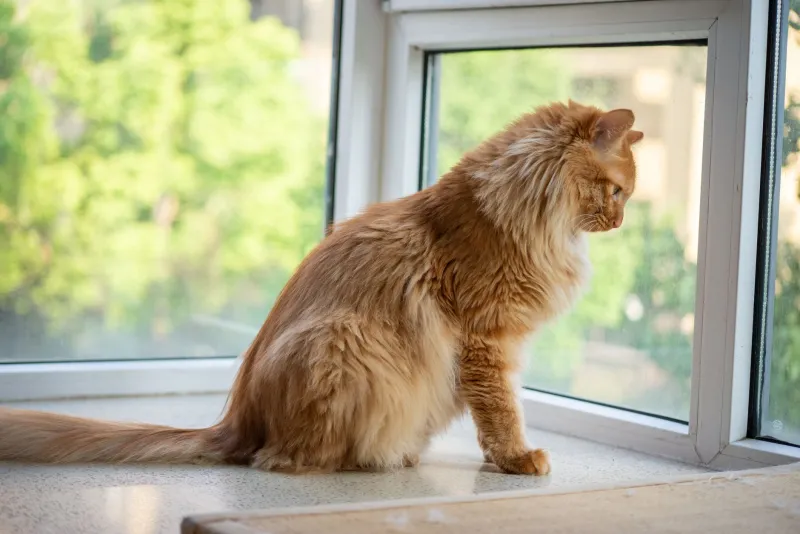
The fix? Invest in tall cat furniture, puzzle feeders, and window perches. A bird feeder outside the window is basically free enrichment TV. If you can swing it, a second cat can also be a game-changer — though that's a whole other article.
Best for: Laid-back, indoor-adapted cats; anxious cats who startle easily; owners with consistent daily routines.
🏡 Suburban Home (Fully Indoor, Larger Space)
Safety: 9 | Enrichment: 7 | Lifestyle Fit: 8 | Total: 24/30
More rooms, more opportunities for your cat to pretend you don't exist — and that's a compliment. Cats in larger homes tend to have more environmental variety, which naturally supports their need to explore, hunt (imaginary prey, presumably), and claim territory. A sunny bay window in the living room? A basement to haunt mysteriously? Chef's kiss.
The main watch-out here is that space alone doesn't equal enrichment. A big, boring house with no stimulation is still a big, boring house. Regular play, rotating toys, and cat-friendly spaces still matter.
Best for: Multi-cat households; more active breeds like Bengals or Abyssinians; owners who work from home and can provide interaction throughout the day.
🌿 The Catio Life (Indoor Cat, Outdoor Enclosure)
Safety: 9 | Enrichment: 9 | Lifestyle Fit: 8 | Total: 26/30
Okay, we'll just say it — catios are the millennial pet parent's magnum opus. A catio (for the uninitiated) is an enclosed outdoor structure that lets your cat experience fresh air, bugs, bird sounds, and the smell of actual grass without the risks of free-roaming. They range from a simple window box to a full backyard enclosure that costs more than your first car.
Dr. Mikel Delgado, a certified cat behavior consultant, has noted in various interviews that outdoor access — even limited, controlled access — can meaningfully improve a cat's quality of life by providing sensory stimulation that indoor environments simply can't replicate. Catios deliver exactly that.
Mia, 28, a teacher in Austin, built a DIY catio for around $200 using YouTube tutorials and a lot of optimism. "My cat Biscuit went from yowling at the back door every morning to just... sitting peacefully in her little outdoor kingdom. It genuinely changed our relationship."
Best for: Cats with high prey drives; owners in areas with significant outdoor risks (coyotes, heavy traffic); anyone who wants to feel like a responsible genius.
🌲 Leash Walking and Harness Training
Safety: 7 | Enrichment: 8 | Lifestyle Fit: 6 | Total: 21/30
Not every cat will accept a harness. Let's just acknowledge that upfront. Some cats treat the harness like a personal insult and will collapse dramatically to the floor the moment it touches their fur. But for cats who do take to it — and with patient training, many can — leash walking offers incredible enrichment on a controlled, owner-managed schedule.
The lifestyle fit score dips here because this approach demands time, consistency, and a willingness to look slightly eccentric walking a cat down your street. (We mean that as a compliment.)
Best for: Curious, adaptable cats; owners who genuinely enjoy spending outdoor time with their pet; people who live near parks or quiet trails.
🐾 Supervised Free Roaming (Outdoor Access with Monitoring)
Safety: 5 | Enrichment: 10 | Lifestyle Fit: 6 | Total: 21/30
This is the most controversial entry, and we knew it would be. Letting your cat roam outdoors — even with supervision — carries real risks: cars, other animals, disease, getting lost. The American Veterinary Medical Association and most animal welfare organizations advise against unsupervised outdoor roaming for domestic cats.
And yet. Many cat owners, particularly in rural and lower-traffic suburban areas, have cats who have lived this way for years. The enrichment is undeniable — cats who roam express more natural behaviors and tend to be physically leaner. The risks are also undeniable.
If you go this route, microchipping, up-to-date vaccinations, regular vet checkups, and a reliable way to call your cat home are non-negotiable. This setup scores lower not as a moral judgment, but as an honest reflection of the statistical risk involved.
Best for: Rural properties with low traffic; cats who were already outdoors-adapted before adoption; owners who are fully informed and have mitigated as many risks as possible.
🏆 So What's the Verdict?
The catio setup edges out as the highest-scoring arrangement overall, and we stand by that — it balances safety and enrichment in a way that few other options can. But the honest truth is that a loving, engaged owner in a studio apartment will raise a happier cat than a checked-out owner on five acres.
The best living situation for your cat is the one where you can consistently provide safety, stimulation, and connection. Know your cat's personality. Know your own lifestyle. And maybe — just maybe — stop letting strangers on the internet make you feel bad about the setup you've thoughtfully chosen.
Your cat is lucky to have someone who cared enough to read a 1,000-word ranking system about their living conditions. That already puts you ahead of the curve.
Now go play with them for 20 minutes. They've been staring at you this whole time.