Your 600-Square-Foot Apartment Can Be a Cat Paradise — Here's How to Actually Pull It Off
Urban renters, this one's for you. You love your cat. Your cat loves you. Your cat also, if we're being completely transparent, is slowly losing their mind from understimulation while you're at work, and the evidence is in your couch cushions.
Indoor cats in small apartments face a very real challenge: a limited territory, no access to outdoor stimulation, and a human who leaves for eight hours a day and comes home wondering why the toilet paper has been completely destroyed. The answer is boredom. It's always boredom.
The good news? You don't need a house, a yard, or a massive budget to fix this. You need a plan, a little creativity, and the willingness to accept that your apartment is now, at least partially, your cat's apartment.
Think Vertical First — Your Walls Are Wasted Space
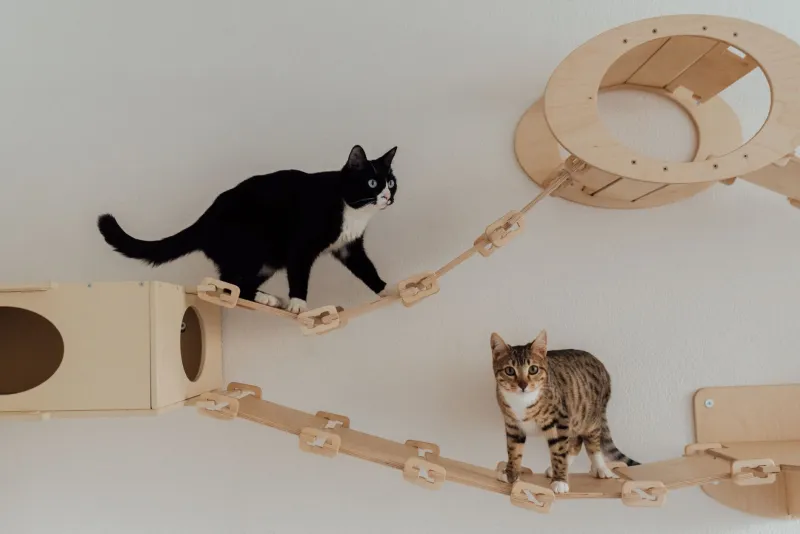
Here is the single most transformative thing you can do for a cat in a small space: go up. Cats are natural climbers. In the wild (and in the imaginative interior life of your domestic tabby), height equals safety, territory, and a tactical advantage. Your apartment's square footage is fixed, but your cubic footage? That's a different story.
Cat wall shelves have become genuinely beautiful in the last few years. Brands like Catastrophic Creations, Refined Feline, and even IKEA hacks have made it possible to build a vertical highway across your walls that looks intentional — even stylish — rather than like you've surrendered your home to an animal. A series of staggered shelves at varying heights, connected by ramps or steps, gives your cat a dedicated travel route that exists entirely above the floor.
For renters worried about wall damage: floating shelves with proper anchors cause minimal damage and patch easily. That's a battle worth having with your security deposit.
Cat trees remain a classic for a reason, but if you've been avoiding them because you live in a small space and don't want a six-foot beige carpet monolith dominating your living room, there are better options now. Slimmer floor-to-ceiling tension pole designs take up minimal floor space while still providing the vertical real estate your cat craves. Put one near a window and you've just dramatically upgraded your cat's daily entertainment situation.
The Window: Stop Underestimating It
Okay, we said your cat deserves better than a window perch — and they do — but that doesn't mean the window itself is useless. A window perch is a starting point, not a complete enrichment strategy.
Here's how to actually maximize your windows:
Bird feeders outside the window turn an ordinary view into live television. A simple suction-cup feeder on the outside of a window, stocked with nyjer seed or sunflower hearts, will attract finches, sparrows, and whatever other species are local to your city. Your cat will develop opinions about specific birds. This is normal and healthy.
Window bird feeders that attach to the glass are a rental-friendly option that requires zero outdoor access. There are even ones designed specifically for cats — with a perch built into the interior mount — that have gone viral for good reason. Your cat pressed against the glass, pupils the size of dinner plates, tracking a chickadee? That's enrichment and content.
Grow cat grass or catnip on the windowsill. A few small pots of cat grass (wheatgrass or oat grass, available at most pet stores) give your indoor cat something to nibble, smell, and interact with that mimics an outdoor sensory experience. It's also very good for their digestion, and watching a cat eat grass with the focused intensity of a gourmet is one of life's quiet pleasures.
DIY Enrichment That Actually Works (And Costs Almost Nothing)
The enrichment industry would love to sell you a $90 puzzle feeder. And some of those are great! But before you reach for your credit card, raid your recycling bin.
Paper bags and cardboard boxes are legitimately excellent cat toys. A paper grocery bag with the handles cut off (important — handles are a strangulation hazard) becomes a tunnel, a hiding spot, and a crinkle-sound machine that cats find deeply satisfying. Rotate boxes regularly to keep the novelty alive.
Muffin tin puzzle feeders. Take a standard muffin tin, put small amounts of kibble or treats in each cup, and cover some or all of the cups with tennis balls. Your cat has to figure out how to get the balls off to access the food. This is a puzzle feeder that costs you literally nothing and engages your cat's brain in a way that a bowl of food never will.
Paper towel roll toys. Fold the ends closed, put treats inside, and let your cat figure out how to extract them. It takes about four minutes to make and your cat will treat it like it's the most important task they've ever undertaken.
Wand toys on a schedule. This one requires your participation, but interactive wand play is irreplaceable. Twenty minutes of active wand play — the kind where you mimic actual prey movement, letting the toy dart and hide and pause — does more for your cat's mental and physical health than a room full of passive toys. The key word is interactive. A wand toy left on the floor does nothing. A wand toy in your hand, wielded with commitment, is magic.
Scent Enrichment: The Underrated Category
Cats experience their world primarily through smell, and most enrichment strategies completely ignore this. Here's how to engage your cat's most powerful sense:
Rotate novel scents. A pinch of dried catnip, a sprinkle of silver vine (which works on cats who don't respond to catnip), or even a small sachet of dried valerian root placed in a toy or on a scratch pad gives your cat something genuinely new to investigate. These are cheap, easy to source online, and will send your cat into a state of bliss that is both hilarious and heartwarming.
Bring nature inside. A pinecone from the park, a handful of leaves in a bag, a stick from outside — novel outdoor smells are intensely interesting to a cat who doesn't get to experience them directly. Let them sniff, investigate, and roll around with whatever you bring in (within reason — avoid anything that might be toxic).
Feeding Strategy as Enrichment
If your cat eats from a bowl on the floor, you are leaving enrichment opportunities on the table. Literally.
Scatter feeding — spreading kibble across a snuffle mat or even just a textured bathroom rug — makes your cat hunt for their food instead of inhaling it in thirty seconds. It slows them down, engages their nose, and turns mealtime into an activity.
Food puzzles range from beginner (a slow feeder bowl with ridges) to advanced (multi-level puzzle boxes with sliding compartments). Start easy and work up. The goal isn't to frustrate your cat — it's to challenge them just enough that success feels rewarding.
Multiple small meals instead of one or two large ones better mimics a cat's natural hunting-and-eating pattern and keeps them more engaged throughout the day. If you're not home to manage this, an automatic feeder with a timer is a worthwhile investment.
The Apartment Enrichment Mindset
The biggest shift isn't any single product or hack — it's starting to see your apartment through your cat's eyes. Where are the hiding spots? Where are the high points? Where does the afternoon sun hit the floor? Where does interesting stuff happen?
A cat who has multiple levels to explore, things to smell and hunt and investigate, windows that offer genuine stimulation, and a human who plays with them intentionally every day — that cat is not suffering for lack of a yard. They're thriving in a space that was thoughtfully designed around their actual needs.
Your apartment can do this. Your cat is counting on you to figure it out.